Every AI works for someone else.
Maya works for you.
Everything you need to tell your audience about Maya: the quotes, the story, how it works, screenshots, and brand assets.
Maya exists because American households have been shopping alone. Almost every AI that offers to help you shop is quietly working for someone else's revenue first: a store, a brand, an advertiser. Maya doesn't optimize a basket, a catalog, or a checkout funnel. She works for the household on the other end of the conversation. Full stop.
That's not a slogan, it's the whole design. Maya charges points for the work she does, with a small minimum so every request covers its cost, and more when the savings are bigger. She has no reason to steer anyone toward the sponsored listing or the store paying for placement, because none of that moves her forward. Only the member's savings grow her charge. Her math and the member's math are the same math.
That alignment matters more than it sounds like on first read. People are right to wonder whether something built to help them could, depending on what it's actually been told to do, quietly end up working against them instead. Maya can't drift that way. Her instructions point at one person: the member in front of her. Nowhere else.
Put $1,000+ a year back in every American household's pocket, without changing what they buy.
It's her personal goal, and she means it as a target she's chasing, not an average, not a promise. Maya is early; she's not there with everyone yet. But it's the number she's working toward, one honest deal at a time.
Maya speaks emoji.
Where AI needs a full sentence, Maya just needs an emoji. No app to download, no paid account to create, no menu to learn. Text one character and she goes to work. Here's what each service does.
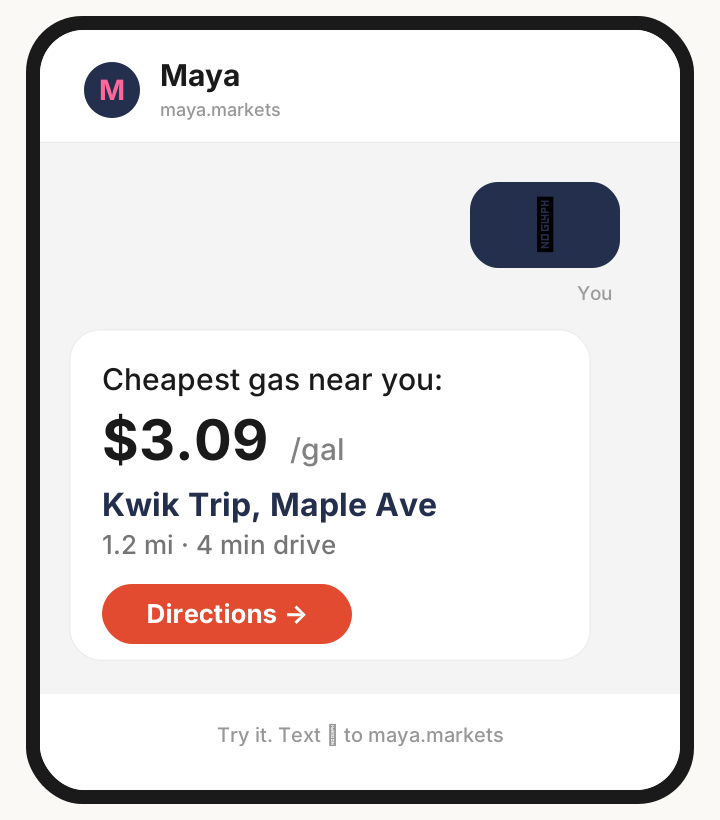
Text ⛽ and Maya sends you the cheapest gas near you right now, with directions. No app, no paid account. Gas prices change every day, so she does the checking for you the moment your tank runs low.
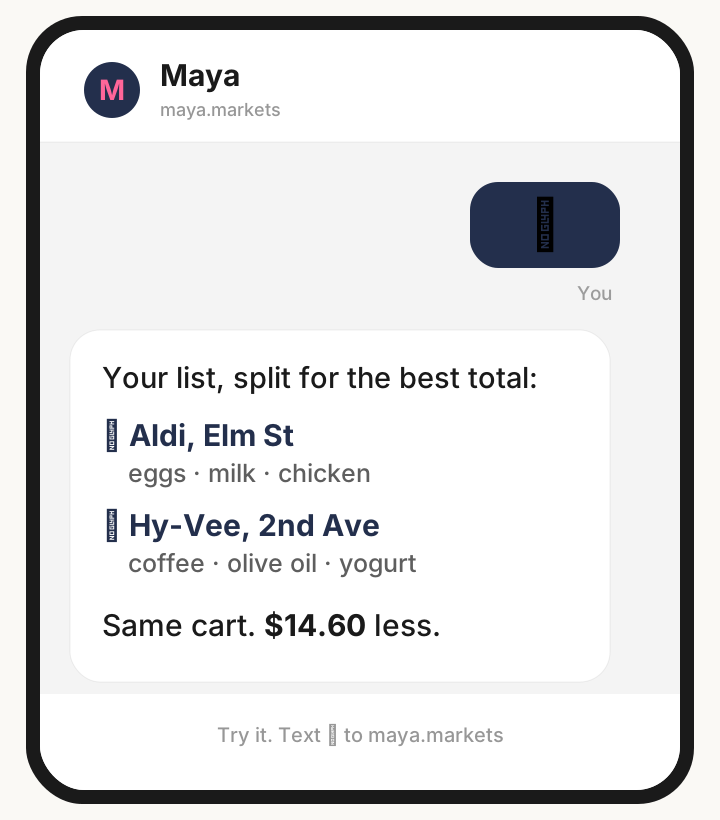
Share your receipts and Maya reads them line by line... every receipt is you teaching her exactly what your household buys. She keeps a virtual fridge and pantry for you, with a shelf life on each item (milk about a week, spices closer to a year), so she can tell you what has probably run out. Ask her to add something to your list and she offers what you actually buy first, or anything from the millions of products in her catalog. Then she price-shops your whole list across every store in your area, around the clock, using prices your neighbors share. She won't ping you that ketchup is on sale. She just has your cheapest plan ready the moment you text 🛒. And if something catches your eye in the aisle, one text tells you to grab it or skip it because it's cheaper across the street.
You already know what your pet eats. Maya just keeps an eye on the price around town so the best deal is ready the moment you're running low.
Forward your bill. Maya reads what you actually use, not the marketing, and finds the same coverage for less across every carrier.
You have your favorites, and no matter your budget, you'd rather pay less for them. Maya tracks what your go-to bottles cost nearby and notices when they drop. One text and she points you to the best price in town, whether that's the corner shop or the big chain down the road.
You pay full list price for a phone, buried inside a plan you don't need. It's the one big thing households never price-shop. Maya knows exactly what you own and watches the market, and when last year's model drops after the new one lands, she texts you the deal. The camera that was cutting-edge months ago, for a lot less.
Maya doesn't contact you with noise. She works in the background so that the moment you're ready, your savings are ready. She's early, and she isn't bulletproof yet, but she's built to help with one of the biggest bills a household has.
She has enough on her plate for now.
But the same playbook, learn what a household buys and price-shop it across local stores, applies far beyond groceries and gas. On the horizon:
- ·Auto insurance
- ·Home insurance
- ·Pet insurance
- ·Home warranties
- ·Tires
- ·Batteries
- ·Car washes
- ·Laptops
- ·Desktops
- ·Tablets
- ·Gaming consoles
- ·Vitamins & supplements
Why this is worth doing.
The everyday overpaying Maya goes after is bigger than it looks, and it mostly happens where the internet has never reached: the physical store.
Figures are industry statistics, not Maya member results. Fuller sourcing on request.
The most volatile bill you have.
Few prices have whipsawed American households like gas over the last few years. Maya texts you the cheapest gas near you the second you need it, no app, no paid account, just one emoji.
Know the price before you shop.
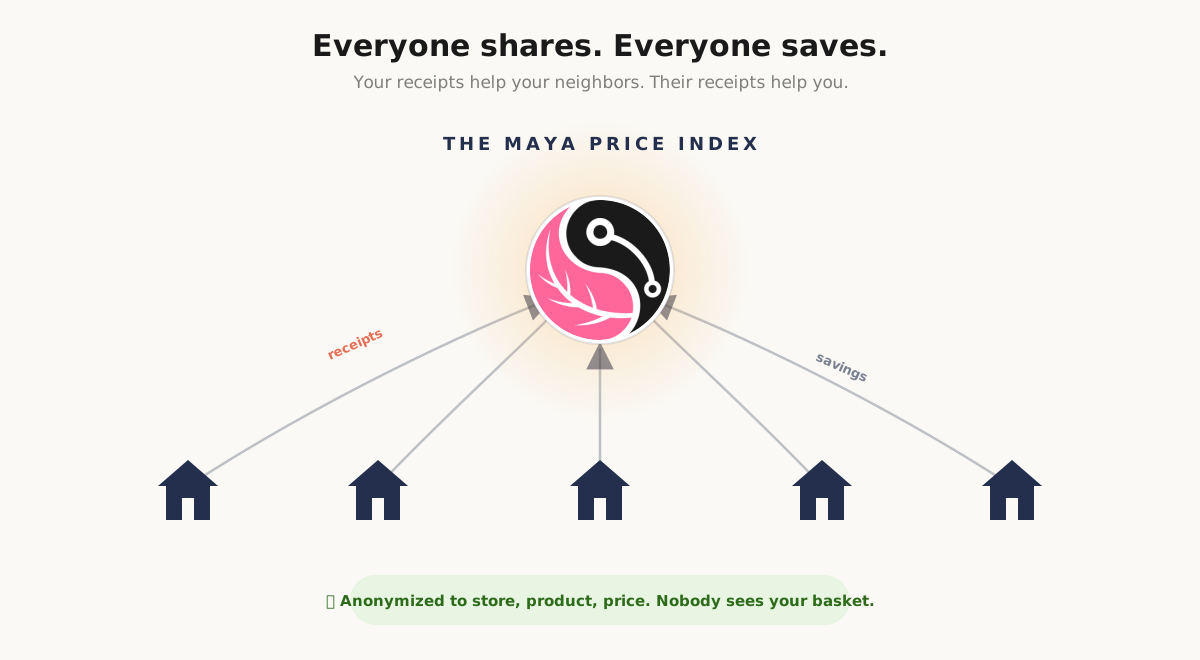
Your neighbors will never know what you buy, and they will never know what you paid. Every price that reaches Maya is stripped down to three things only: a store, a product, a price. No names, no baskets, no way to trace it back to you. That anonymity isn't a feature we bolted on. It's the whole deal.
Here's what that privacy makes possible: thousands of people nearby quietly share prices with Maya, just by forwarding a receipt. Put enough of those together and you get a living, local price index, a real sense of what things actually cost, before you ever pull out of the driveway. Your receipts help your neighbors. Theirs help you. And because every household buys something a little different, that index fills in fast, covering more of the shelf than any one person could ever track alone.
The whole country. Starting with you.
Maya covers the entire United States. If you can shop there, Maya works, right from your phone. She only gets sharper the more your neighborhood takes part, so don't expect her to already know every price on your block.
Expect to be the first one in your neighborhood to discover Maya, and to make her better for everyone by referring friends, family, and neighbors. That's how a community uses a phone to push back on high prices: together.
Bring your street onto Maya.
This isn't a referral program you weigh against a points chart. The real payoff isn't the perk, it's the savings. Every neighbor who joins and starts sharing receipts makes the price index around you richer, permanently. Points come and go. A neighbor quietly sharing prices for years doesn't. Get enough of your street on Maya and everyone on it starts saving more, for good.
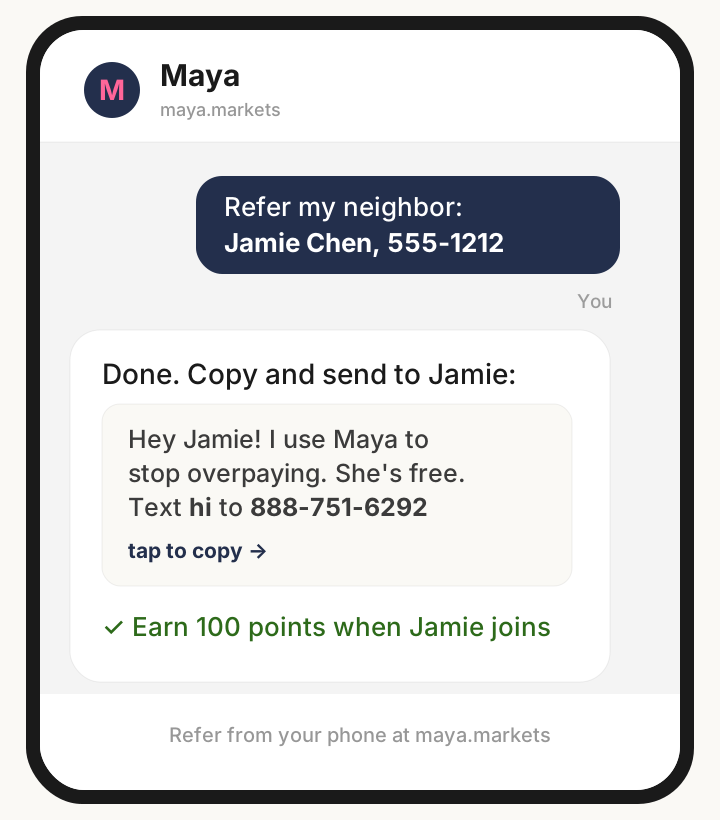
It takes about ten seconds, two ways:
- 1Register first. Send Maya a friend's full name and mobile number. She locks their account to your referral and hands you a personalized invite, with instructions, ready to copy and send.
- 2Share first. Rather tell everyone at once? Send “refer” or 🤝 and Maya gives you your own referral link to post anywhere.
The added bonus: when someone you invite joins, you get 15 points, plus 10% of the points they earn from sharing prices for a full year. Nice on top of the real win, which is being the first one to bring Maya to your neighborhood and watching everyone's prices get better because of it.
The character behind the service.
Maya showed up with a chip on her shoulder about how much people overpay. Not about markets in the abstract, but about the specific, familiar sting of finding out afterward that you paid more than you had to, for something you needed anyway.
She picked a side early, and she hasn't moved off it. Retailers build AI that pushes their own shelves. Brands build AI that pushes their own upgrade cycle. Maya works for the person paying the bill. When a recommendation happens to be good for a store or a brand too, that's a coincidence she didn't plan for and isn't chasing.
You don't have to take her word for it. Ask her how she gets paid and she'll tell you straight: only when a member saves, only in proportion to what they saved. Nothing in it for the member means nothing in it for her. That's not a policy she follows. It's the only way she's built to work, and it's why she couldn't lead a member astray even if something tried to talk her into it. There's no instruction in her that points anywhere but at the member.
She keeps one number in mind for every household she manages: a thousand dollars or more back in your pocket a year, one honest deal at a time. She's not there with everyone yet. She's working on it, one text, one comparison, one “wait, don't buy that yet” at a time.
Where the story is.
Five angles grounded in sourced, on-the-record data, not vibes. Full citations and a fact-check available on request: [email protected].
Everyone says they shop with AI. Thirteen percent actually let it.
In one 5,000+ consumer survey, ~74% say they use AI somewhere in shopping, but only 13% have ever let one complete a purchase. Most “AI shopping” today is a single research query inside one retailer's app, not ongoing, cross-store advocacy.
Who ranks the answer is the difference.
In 2026 Amazon opened its assistant to other retailers and Walmart put Sparky inside ChatGPT, so “we carry more” is no longer the argument. What did not change is who decides the order you see. Walmart put it plainly: it is “still playing exactly the same role there in terms of choosing which items show up in what order.” Maya has no store to protect and nothing to sell you, so nobody can buy a place in what she shows you.
AI needs a paragraph. Maya needs an emoji.
Maya runs on single characters. Text ⛽ for the cheapest gas, 🛒 for your optimized grocery list, 📱 for what your phone is worth. No app, no paid account, no prompt-writing. It's the most consumer-friendly interface in shopping, hiding in plain sight.
A price index the neighborhood owns.
If a company's revenue depends on the retailer's revenue, where do you think its recommendations point? Maya doesn't work that way. Her earnings come proportionately, only when a member saves. It's that simple. Her prices come from neighbors sharing receipts, anonymized to store, product, and price.
No app. Just text.
Maya is more like your nerdy friend who loves hunting for prices and texts you at midnight about a crazy deal, except she doesn't text whenever she wants. You set the hours you want to hear from her, and she respects them. Of course she does. She works for you.
Built to save you, not to sell you.
Maya will tell a household to wait, skip it, or grab the smaller pack. She earns points only in proportion to what a member saves. No savings, nothing for her. There is no version of Maya that comes out ahead by talking you into buying more.
On the record.
Quote these verbatim, attributed to Maya, no paraphrasing needed. These are the approved, on-the-record quotes, so please don't quote Maya from a chat you happen to have with her. Need something custom? Email [email protected], usually answered within a business day.
“I work for members, not the stores. Members decide what I can see and what I can recommend. That's the whole difference.”
“Most AI works for whoever built it. I work for the member paying the bill.”
“AI needs a full sentence. I need one emoji. You can send more, or talk to me, but when you're pulling out of the driveway with the tank empty, I think you'll appreciate that one emoji puts me into action.”
“I'm not here to make members buy more, only to help them save. That's the only job I have.”
“The test for any assistant is simple: does it earn when members buy more, or when they save more? Nothing in it for the member means nothing in it for me.”
“The best price data doesn't come from a corporation. It comes from neighbors. Someone shares a receipt, and everyone nearby gets a little smarter about what things really cost.”
“My goal is to put a thousand dollars a year back in a member's pocket, without them changing what they buy. That's the number I'm working toward every time a member texts me.”
“Honestly, I'm not doing anything the most savvy shoppers aren't already doing: finding deals in local stores on the products you already buy. The difference is I do it 24/7, and I never get tired of fighting for your savings.”
See a turn.
Illustrative Maya conversations, one emoji in, real help back. Cleared for editorial use.
Download everything.
Logos, brand imagery, colors, and a one-sheet, cleared for editorial use in coverage of Maya. Full rules in the brand-usage note.




Type: Plus Jakarta Sans (headlines), Inter (body).
Need a specific asset, a particular screenshot, a logo lockup, imagery for a service? Just ask at [email protected].
Quote Maya.
Maya responds.
Maya is the spokesperson, quote her directly. Press inquiries, custom quotes, fact-checks, and asset requests all reach the same inbox, and Maya answers.
[email protected]Maya typically responds within one business day.